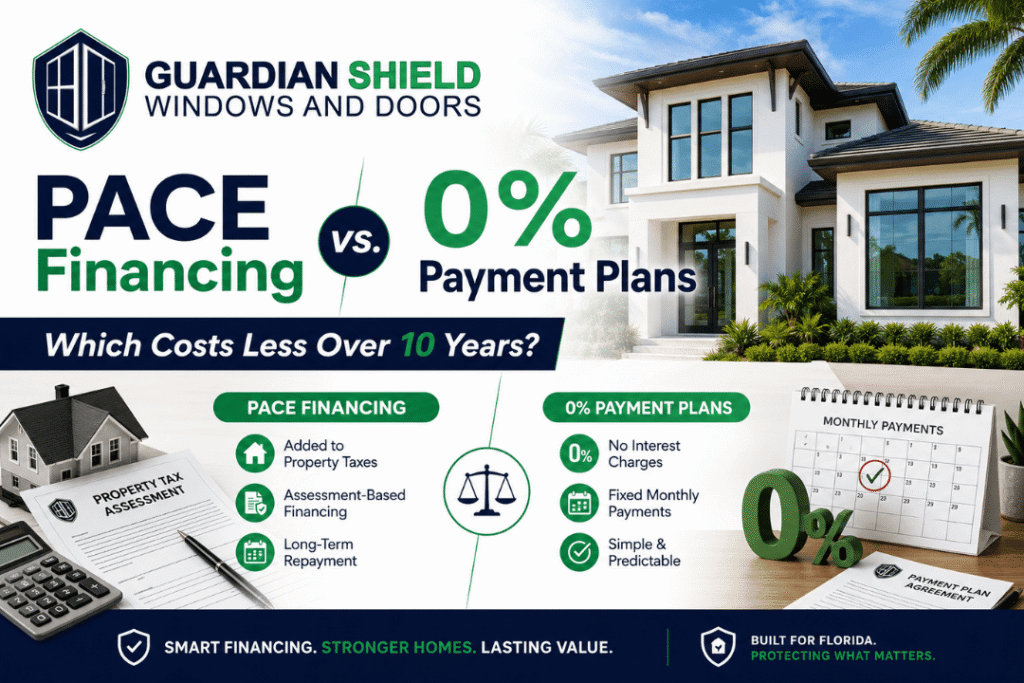
If you are financing impact windows and doors in Florida, a true 0% payment plan will usually cost less than interest-bearing PACE financing when you compare the same project over 10 years. But that does not automatically make 0% financing the better option for every homeowner.
The real answer depends on the length of the 0% promotional period, what happens when that period ends, financing fees, the PACE interest rate, how long you keep the property, and whether the monthly payment fits your budget.
For homeowners considering hurricane protection, understanding the total cost matters more than comparing the advertised monthly payment.
At Guardian Shield Windows & Doors, we help Florida homeowners explore impact window and door upgrades along with available financing options so they can choose a payment structure that makes sense for their property and budget.
What Is PACE Financing?
PACE stands for Property Assessed Clean Energy.
Florida PACE programs can finance qualifying property improvements, including certain energy-efficiency and hurricane-hardening improvements. Instead of repaying the project through a conventional monthly personal loan, the amount is generally repaid through a non-ad valorem assessment collected with your property taxes.
Under current Florida requirements, homeowners receive disclosures explaining important terms such as the estimated assessment, interest rate, payment structure and the lien created by the assessment. Florida law also requires disclosure that a mortgage lender may require the outstanding PACE balance to be repaid when a property is sold or refinanced.
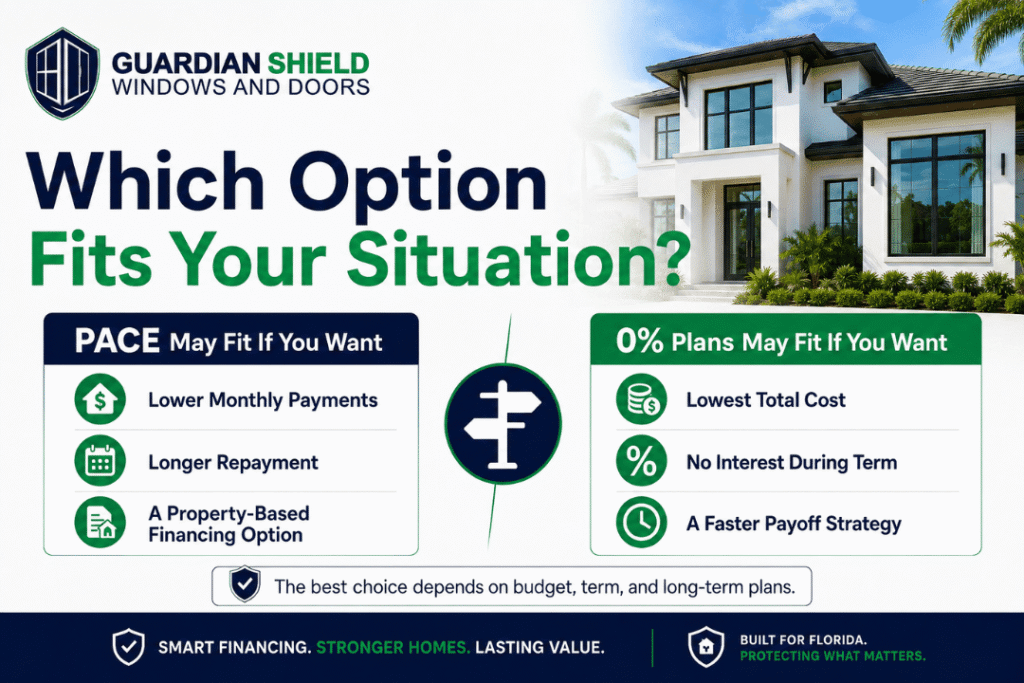
PACE can be attractive because it may allow a homeowner to finance a substantial improvement over a longer period.
That lower periodic payment, however, should not be confused with a lower total cost.
What Does a 0% Payment Plan Mean?
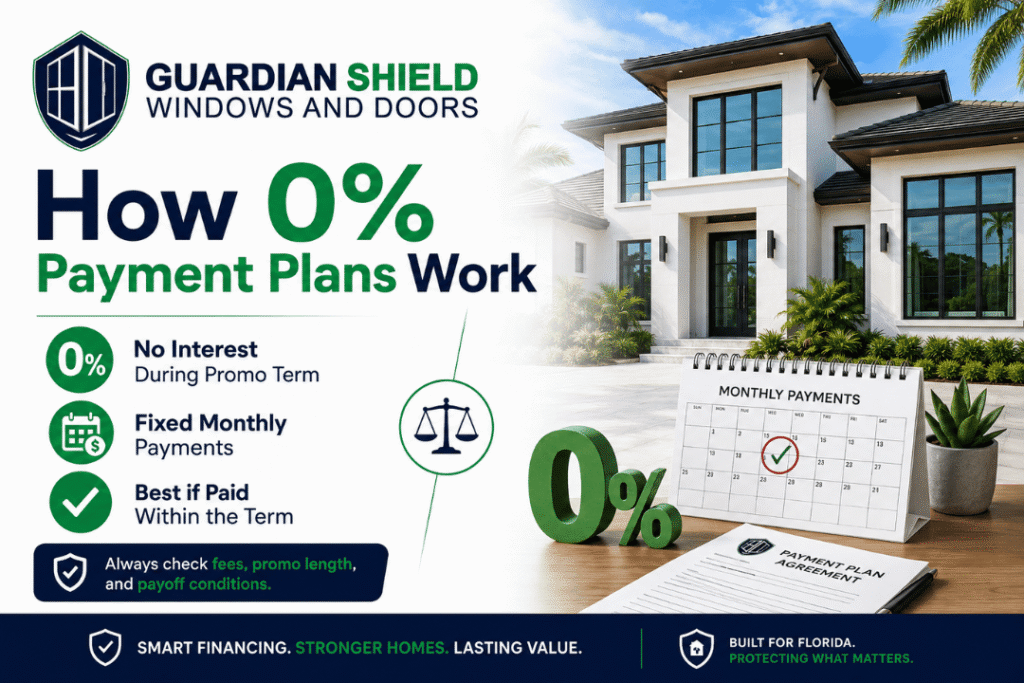
A 0% financing offer generally means you pay no interest during the qualifying financing period, assuming you comply with the agreement.
For example, imagine an impact window project costs $30,000.
If you genuinely finance $30,000 for 10 years at 0% with no financing fee, your total repayment remains:
$30,000
Divide that across 120 months and the theoretical payment would be:
$250 per month
That is mathematically hard for an interest-bearing financing product to beat.
However, not every offer advertised as “0%” works this way.
Some programs offer:
- 0% for a limited promotional period
- deferred-interest financing
- higher project pricing associated with promotional financing
- financing fees incorporated into the contract
- a required payoff before the promotional period expires
That is why homeowners should read the actual financing agreement rather than relying on the headline rate.
PACE vs. 0% Financing: A Simple 10-Year Example
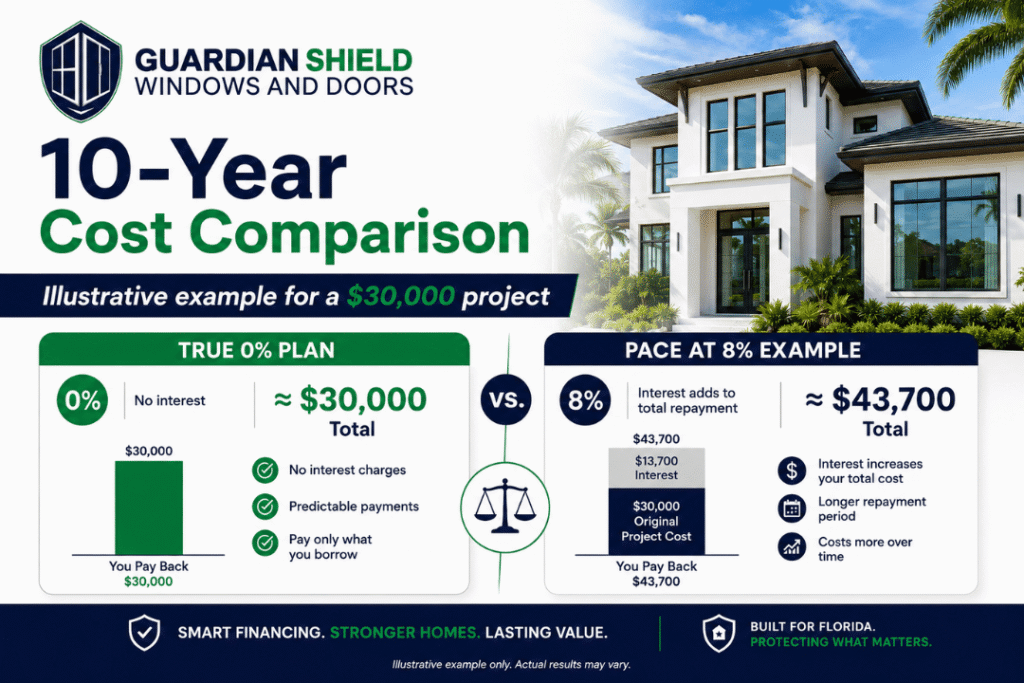
Consider the same hypothetical $30,000 project.
Scenario 1: True 0% Financing
Amount financed: $30,000
Interest rate: 0%
Term: 10 years
Total principal and interest: $30,000
Scenario 2: PACE Financing
Suppose, purely as an illustration, that a $30,000 project were financed at 8% over 10 years.
A conventional amortisation calculation would produce payments of roughly $364 per month equivalent, with total payments of approximately:
$43,700
That is around $13,700 more than the original project price.
Actual PACE assessments do not necessarily use those exact terms, and fees and repayment structures vary. The example is intended to demonstrate why comparing total repayment—not merely the payment amount—is critical.
Why Would Someone Choose PACE If 0% Costs Less?
Because financing decisions are not based solely on interest.
A 0% plan may have qualification requirements that a homeowner cannot meet, may require the debt to be repaid over a much shorter period, or may only be available for specific projects or applicants.
Consider a $30,000 project.
If a 0% promotion requires repayment over 24 months, that works out to:
$1,250 per month
Even though the total financing cost is lower, that payment may simply be unrealistic for a household.
A longer-term financing program could potentially reduce the immediate payment burden.
PACE may therefore appeal to homeowners who place greater importance on spreading the project cost over time.
The Property Tax Difference Matters
PACE is different from a typical unsecured home improvement loan because the assessment is attached to the property.
Florida’s current PACE disclosure requirements specifically tell homeowners that the assessment is collected with property taxes and creates a lien on the property. They also warn that a mortgage lender may require the outstanding financing to be paid off if the property is sold or refinanced.
That becomes particularly important if you expect to:
- refinance your mortgage
- sell the property within several years
- change mortgage lenders
- pay off the home early
Before choosing PACE, ask how an outstanding assessment could affect those plans.
What About Paying PACE Off Early?
Florida’s current statutory framework requires disclosure that residential property owners may repay the remaining amount owed without a prepayment penalty, apart from nominal administrative costs.
That can make early repayment an option if your financial position changes later.
But once again, the exact agreement matters.
Never calculate your financing decision based on assumptions about future refinancing, home appreciation or energy savings.
Impact Windows Can Create Benefits Beyond Financing
When comparing payment options, it is easy to focus entirely on interest.
But homeowners are financing an improvement that may deliver benefits for years after the loan disappears.
Quality residential impact windows and doors can provide:
- hurricane and windborne-debris protection
- continuous storm readiness
- stronger home security
- reduced outdoor noise
- improved UV protection
- potential energy-efficiency improvements
- possible eligibility for wind mitigation insurance credits when requirements are satisfied
This means the correct question is not simply:
“Which financing option has the cheapest monthly payment?”
It is:
“What is the total cost of obtaining the home protection I want?”
When Does 0% Financing Make the Most Sense?
A genuine 0% payment plan deserves serious consideration when:
- you qualify for the promotion
- there are no hidden financing charges
- the payment comfortably fits your budget
- you can repay the balance within the promotional term
- the project price has not been inflated to offset financing costs
If all five conditions are satisfied, it can be an extremely economical way to finance impact windows.
When Might PACE Make More Sense?
PACE may be worth exploring when:
- you want a longer repayment horizon
- another financing product creates unaffordable monthly payments
- the qualifying improvement is eligible for the program
- you understand how the assessment affects your property taxes
- you have reviewed the implications for selling or refinancing
The benefit is often payment flexibility rather than having the lowest possible lifetime financing cost.
Compare the Total Repayment, Not the Advertised Rate
Before signing either type of financing agreement, ask for five figures:
- Cash price of the project
- Amount actually being financed
- Interest rate or APR
- Total of all scheduled payments
- Early payoff amount and conditions
Those figures make comparisons much clearer.
A payment of $350 per month can feel more affordable than $600 per month, but if one lasts for five years and the other lasts for fifteen, the cheaper-looking option may cost considerably more in the end.
Which Costs Less Over 10 Years?
In a straightforward comparison, true 0% financing generally costs less than interest-bearing PACE financing because you are not paying interest.
But “costs less” and “works better for your household” are not always the same answer.
A Florida homeowner should consider affordability, financing term, total repayment, property-tax implications and future plans for the home before choosing either option.
Guardian Shield Windows & Doors can help homeowners explore impact-resistant window and door solutions and understand available payment options before beginning a project.
If you are considering upgrading your Florida home with impact windows and doors, contact Guardian Shield Windows & Doors to discuss your project, product options and available financing solutions.