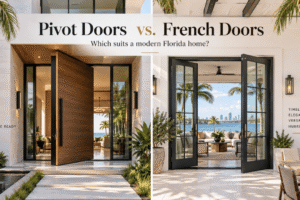
Pivot doors and French doors can both complement a modern Florida home, but they create different architectural experiences.
Pivot doors feature an offset pivot mechanism that allows a large door panel to rotate around a vertical axis. They are frequently used to create oversized, contemporary entrances.
French doors typically consist of two hinged panels that open from the centre, making them suitable for entryways, patios and spaces that benefit from a wide opening. Hurricane protection, design-pressure requirements, water resistance, opening clearance, maintenance and budget all need consideration.
What Is a Pivot Door?
A pivot door rotates using pivot hardware positioned at the top and bottom of the door rather than conventional hinges installed along the side of the frame.
This creates a distinctive opening movement and can accommodate large, architecturally prominent door panels.
Pivot doors are frequently used in modern homes featuring:
- oversized front entrances
- high ceilings
- minimalist architecture
- substantial entrance panels
- contemporary metal, wood or glass finishes
The large door panel can create a dramatic visual effect, particularly when viewed from the exterior. However, the pivot mechanism also means the usable clear opening and swing clearance must be evaluated carefully.
What Are French Doors?
French doors consist of two hinged door leaves that meet at the centre. One panel may function as the primary operating door, while the other can be secured or opened when a wider passage is needed.
French doors are often associated with traditional architecture, but contemporary aluminium frames, large glass panels and minimalist hardware can create a modern appearance.
Common applications include:
- patio entrances
- poolside access
- living rooms opening onto terraces
- formal entryways
- bedrooms with exterior access
French doors can provide a strong visual connection between interior and outdoor spaces.
Pivot Doors vs. French Doors: Key Differences
| Feature | Pivot Doors | French Doors |
| Operation | Rotates on pivot hardware | Swings on side hinges |
| Appearance | Large, contemporary statement panel | Symmetrical paired-door design |
| Typical use | Feature front entrance | Front entry, patio or terrace |
| Opening layout | Part of the panel rotates behind the pivot | One or both hinged leaves open |
| Hardware | Pivot system and compatible locks | Hinges, locking hardware and meeting stile |
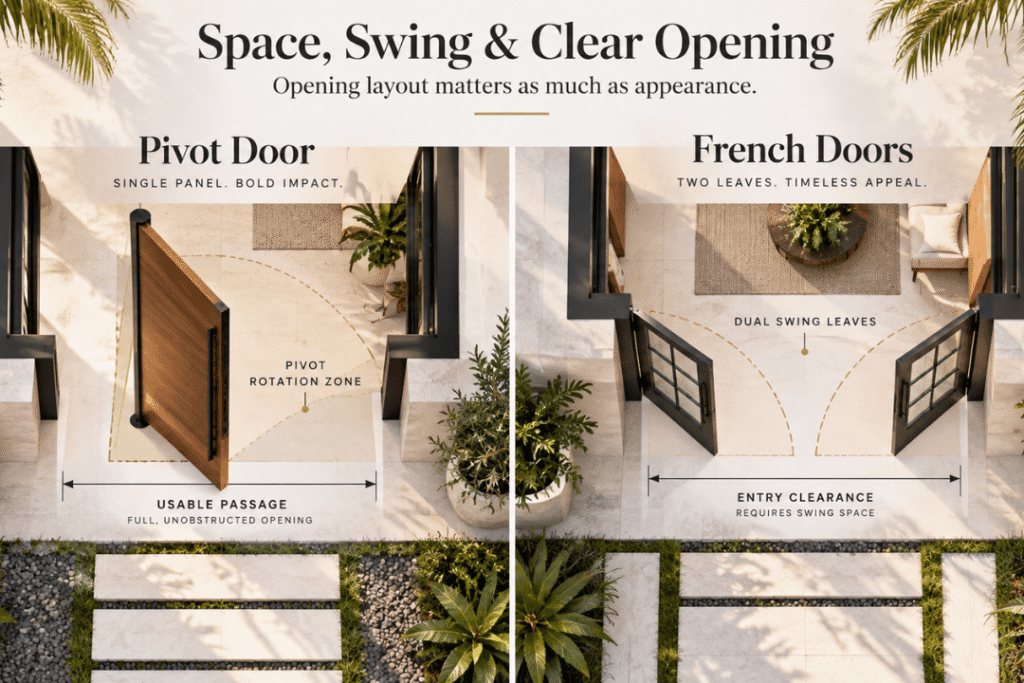
| Space requirements | Requires clearance around the rotating panel | Requires room for the door-leaf swing |
| Hurricane protection | Available in approved impact configurations | Available in approved impact configurations |
Neither door type is automatically more hurricane resistant. The exact approved assembly and its performance limitations determine suitability.
1. Which Door Style Looks More Modern?
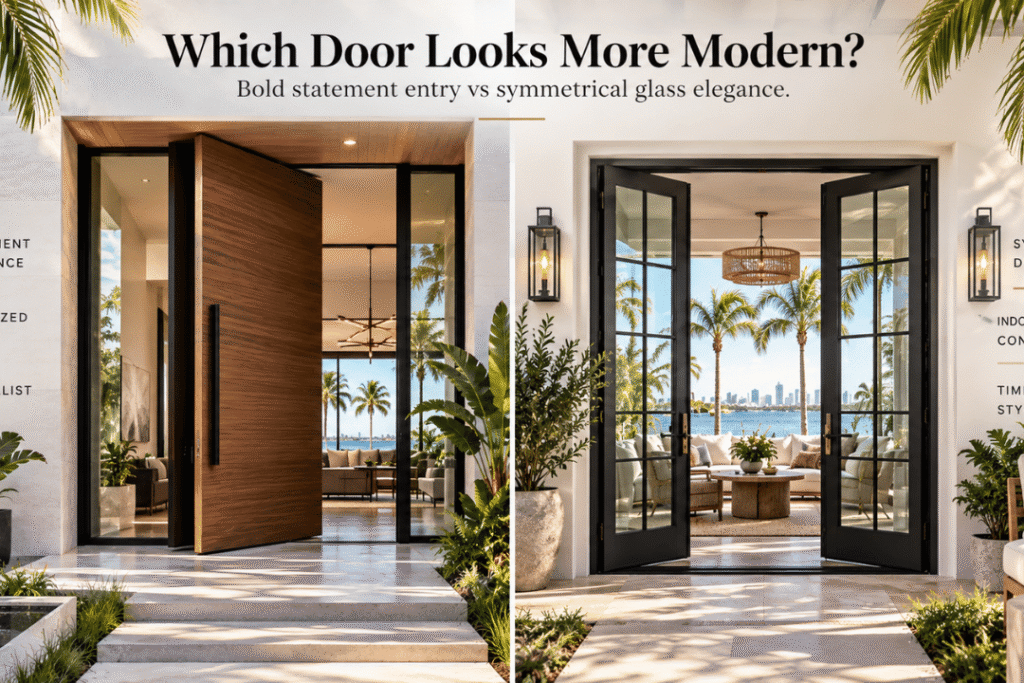
Pivot doors are frequently associated with contemporary architecture. Their large panel, concealed hardware possibilities and distinctive opening movement can create a strong visual feature.
They are particularly suited to homes with oversized entrance walls and minimalist exterior designs. French doors can provide a different kind of modern appearance.
Narrow aluminium frames and expansive glass panels can create a clean, symmetrical design. For homes that emphasise indoor-outdoor living, French doors can provide a visually open connection to patios and gardens.
2. Which Offers Better Hurricane Protection?
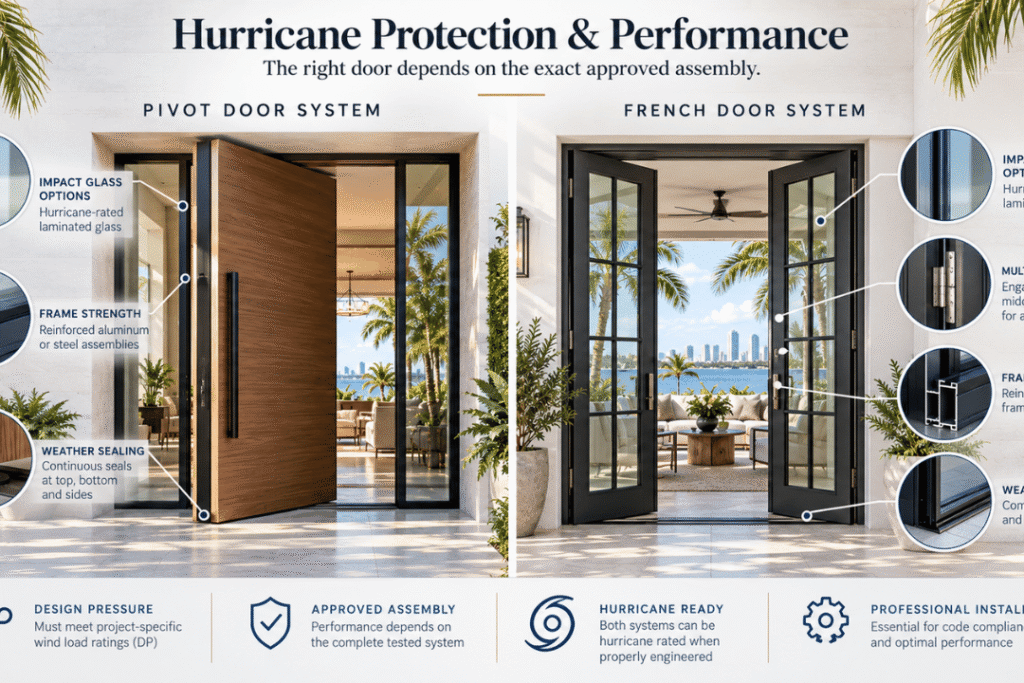
Both pivot doors and French doors are available in impact-resistant configurations suitable for particular Florida applications.
For example, Florida’s product-approval records include the Euro-Wall Euro-Pivot impact door, evaluated for use in the High Velocity Hurricane Zone. Other approved pivot models have different limitations, including products restricted to use outside the HVHZ.
This demonstrates why homeowners should never assume that every impact-labelled pivot door is suitable for every Florida property.
Hurricane performance depends on the complete door assembly, including:
- frame construction
- panel construction
- impact glazing, where applicable
- locking hardware
- anchoring
- design-pressure ratings
- maximum approved dimensions
- installation requirements
Florida’s product-approval framework applies to exterior doors and establishes the relevant approval pathways. Before selecting either style, confirm that the exact configuration satisfies your home’s requirements.
3. Which Door Provides a Wider Opening?
The answer depends on the dimensions and configuration. A large pivot door can accommodate an oversized entrance panel.
However, because it rotates around an offset pivot, part of the panel occupies space within the opening when the door is open. Its clear passage width is therefore not necessarily equal to the full panel width.
French doors can provide a wide opening when both leaves are opened. This can be useful for moving furniture or creating a connection between indoor and outdoor entertaining areas.
For an accurate comparison, request the actual clear opening dimensions of each proposed product. Do not rely solely on the nominal door size.
4. Space Requirements and Door Swing
Door swing is especially important when designing an entrance. A pivot door may require clearance on both sides of its pivot axis as it rotates.
Furniture, walls and nearby fixtures can interfere with its movement if the entrance is poorly planned. French doors require sufficient space for their hinged leaves to swing.
Depending on the product and application, the leaves may open inward or outward. For a patio, consider how the open doors interact with outdoor furniture and circulation areas.
For a front entrance, think about the relationship between the door, entrance steps, landscaping and interior furnishings. The door should suit the available space rather than forcing the homeowner to redesign the surrounding area after installation.
5. Water Resistance in Florida’s Climate
Florida homes experience heavy rainfall, wind-driven rain and high humidity. Water resistance is therefore an important part of exterior door selection. Pivot doors and French doors use different hardware and sealing arrangements.
Homeowners should review the product’s water-penetration performance and installation requirements, especially for exposed entrances.
A sheltered front entrance may experience different conditions from an exposed ocean-facing opening. An impact rating does not automatically mean a door is watertight under every condition.
6. Which Door Is More Energy Efficient?
Glass area, frame material, thermal breaks, weatherstripping and glazing specifications all influence performance. However, larger glass areas may increase solar heat gain unless suitable glazing is selected.
For Florida properties, homeowners should consider Low-E glass and the solar heat gain characteristics of the proposed product. The amount of energy lost through air leakage also depends on the door’s sealing performance and installation.
7. Maintenance and Hardware
The weight of a large door panel makes correct hardware selection and installation particularly important. Maintenance may involve checking the pivot mechanism, locking hardware, alignment and seals.
French doors use side hinges and a meeting-stile arrangement where the two panels connect. Their maintenance may involve hinge adjustment, locks, weatherstripping and the hardware securing the secondary leaf.
Choose hardware and finishes suitable for the expected environmental exposure and follow the manufacturer’s maintenance instructions.
8. Are Pivot Doors More Expensive Than French Doors?
Pivot doors can involve higher project costs when they use oversized panels, specialised hardware or extensive customisation.
However, a large custom impact-rated French door system may also be expensive.
Pricing depends on:
- overall dimensions
- materials
- glass configuration
- impact rating
- design-pressure requirements
- finish
- hardware
- structural modifications
- installation difficulty
A standard-sized French door should not be compared directly with an oversized custom pivot door when assessing cost.
9. Can You Replace French Doors With a Pivot Door?
An existing opening may need modification to accommodate the pivot hardware or different frame dimensions. The usable opening, floor conditions and surrounding structure also need consideration.
If the entrance is enlarged or structurally modified, additional engineering or permitting requirements may apply. The replacement door must be appropriate for the property’s applicable wind and impact requirements. A professional installer should evaluate the opening before a custom pivot door is ordered.
10. Which Is Better for a Front Entrance?
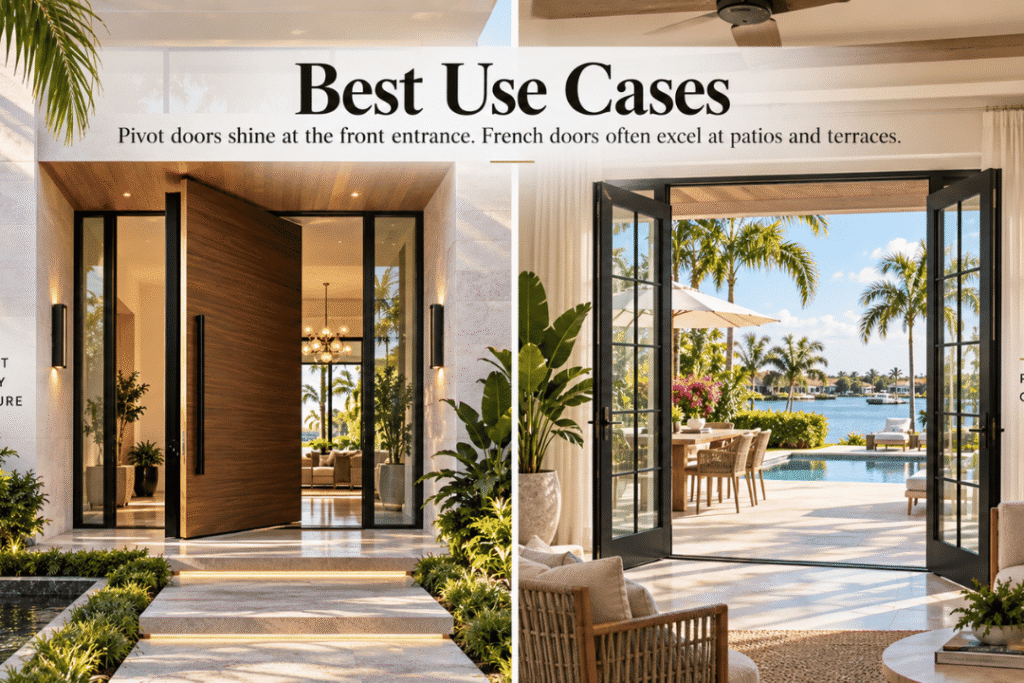
Pivot doors and French doors create different entrance experiences. A pivot door is often considered when the design calls for a large, singular architectural feature.
French doors may suit an entrance where symmetry, glass visibility and the flexibility of two operating leaves are priorities. Consider how frequently the entrance will be used, whether it needs to accommodate large furniture and how the opening interacts with the surrounding space.
Also verify the required clear opening, applicable egress requirements and storm-performance specifications. A dramatic entrance is only successful when it also functions properly.
11. Which Is Better for a Patio?
French doors are commonly used for patio and terrace access because paired panels can create a broad connection between indoor and outdoor areas. Pivot doors can also be used in suitable applications, although their rotating movement and clearance requirements need particular attention.
The location’s wind exposure, weather protection and intended traffic flow should help determine which product configuration is appropriate. For very wide openings, homeowners may also wish to compare impact sliding or folding doors.
How to Choose Between Pivot Doors and French Doors
Before purchasing either door style, compare the exact proposed products. Confirm their dimensions, clear opening, Florida approvals, design-pressure ratings, water performance and installation requirements.
Consider the architecture of the home, the available opening clearance, maintenance needs and installed cost. A large pivot entrance and a contemporary French door system can both work in a modern Florida home.
The decision should reflect the property’s design and the way the entrance will be used.
Explore Custom Impact Doors With Guardian Shield
Guardian Shield Windows & Doors offers residential impact door solutions for Florida homeowners, including pivot doors and other architectural entrance systems.
Whether you are planning a statement front entrance, replacing existing French doors or exploring modern impact-resistant glazing, our team can help you compare suitable configurations.
We can discuss your property’s opening dimensions, design requirements and available door options.
Contact us today to explore pivot doors, French doors and custom impact-resistant entrance solutions for your Florida home.