Florida homeowners frequently ask a seemingly simple question:
“What hurricane rating do my impact windows need?”
Unfortunately, there isn’t one universal rating that every Florida home needs.
Two homes on the same street can potentially have different window pressure requirements. Even different windows on the same house can require different design pressures.
The correct impact window depends on factors such as:
- property location;
- design wind speed;
- building height;
- building shape;
- exposure;
- opening size;
- opening location;
- positive and negative wind pressures;
- impact-protection requirements; and
- whether the property is located in the High Velocity Hurricane Zone.
That is why purchasing a window based solely on a manufacturer’s advertised “hurricane rating” can be misleading.
Here’s what Florida homeowners should understand before selecting impact windows or doors.
What Does an Impact Window Rating Mean?
There isn’t a single number that completely describes the performance of a hurricane impact window.
Several ratings and approvals may be relevant.
These can include:
- impact classification;
- Design Pressure;
- positive pressure;
- negative pressure;
- Florida Product Approval;
- Miami-Dade Notice of Acceptance;
- applicable wind-borne debris requirements; and
- HVHZ approval where required.
Understanding the difference is critical.
What Is Design Pressure?
Design Pressure, often abbreviated as DP, represents the pressure a window or door system is approved to resist under specified conditions.
It is usually expressed in pounds per square foot:
psf
You might encounter a window approval listing something such as:
+60 / -70 psf
These are not wind speeds.
They are pressure values.
Miami-Dade permit guidance specifically requires the positive and negative pressures of windows and doors to be shown where applicable, with those values typically found in product approval documentation.
What Is Positive Design Pressure?
Positive pressure occurs when wind pushes toward the building surface.
Imagine hurricane winds striking the front wall of your home.
The windows on that surface may experience inward pressure.
What Is Negative Design Pressure?
Negative pressure involves suction pulling away from the building.
Wind moving around and over a structure can create suction forces on other surfaces.
That’s why approved window documentation commonly contains both positive and negative values.
A window needs to satisfy the applicable requirement—not merely have an impressive-looking DP number.
Does DP50 Mean the Window Can Handle a 50 MPH Hurricane?
No.
This is one of the most common misunderstandings surrounding impact windows.
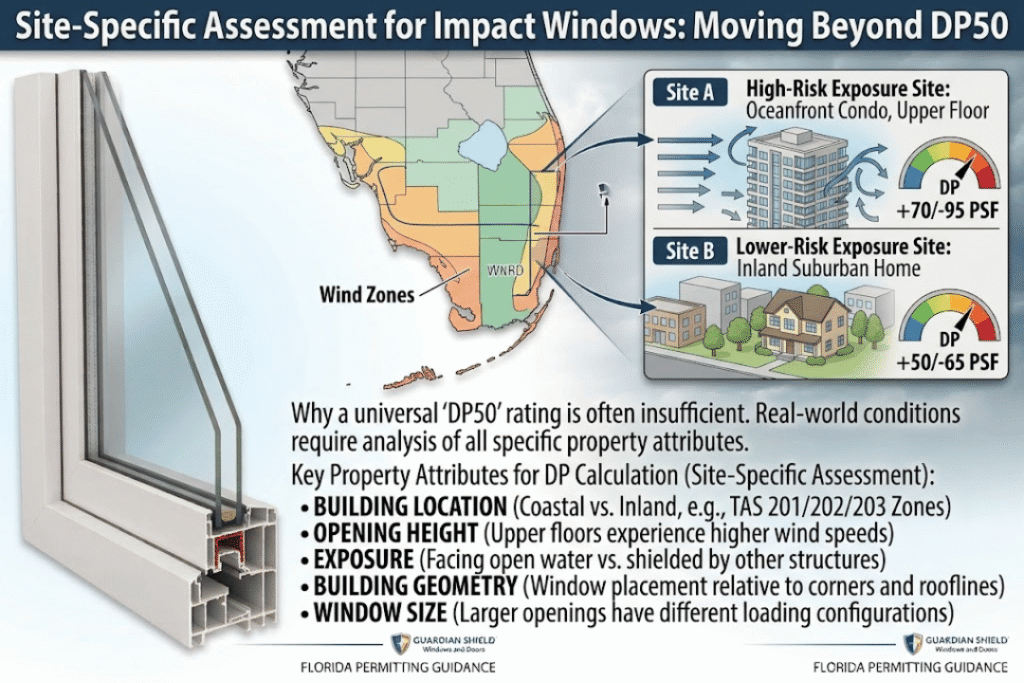
DP50 does not mean 50 mph.
Design Pressure is expressed in pounds per square foot, not miles per hour.
Wind pressure on a building depends on much more than the basic wind speed.
Factors can include:
- structure height;
- terrain exposure;
- building shape;
- roof geometry;
- location on the wall;
- opening size; and
- pressure coefficients.
That is why homeowners should avoid converting a DP rating into a simplistic “hurricane category.”
Why Can Different Windows on My House Require Different Ratings?
Wind does not act uniformly across a building.
Areas near corners and edges can experience different pressures from areas closer to the centre of a wall.
Window size matters too.
Product approvals demonstrate that allowable design pressure can change according to window dimensions and configurations.
As a result, one large living-room opening may require a different approved configuration from a smaller bedroom window.
This is also why a contractor shouldn’t simply say:
“We use DP50 windows on every house.”
The building and openings should determine what is required.
What Is an Impact Rating?
Design Pressure and impact resistance are related to hurricane performance, but they are not the same thing.
Impact testing examines how the glazing or protective assembly responds to debris impact and subsequent testing requirements.
Approved products may be identified as:
- large-missile impact resistant;
- small-missile impact resistant; or
- non-impact.
Some current Miami-Dade approvals explicitly identify products as large- and small-missile impact resistant and approved for HVHZ applications.
The required protection depends on the project’s applicable code conditions.
What Is a Wind-Borne Debris Region?
Wind-borne debris requirements exist because broken exterior glazing can create serious problems during extreme wind events.
When exterior openings need debris protection, compliance may be achieved using approved impact-resistant glazing or approved protective systems depending on the applicable requirements.
Florida Building Code educational material explains that glazed openings in designated wind-borne debris regions require protection using impact-resistant glazing or impact-resistant coverings.
For homeowners, the important takeaway is:
Not every property should be evaluated simply by asking how many miles it is from the beach.
Code-based wind and debris requirements should be determined for the actual property.
What Is the High Velocity Hurricane Zone?
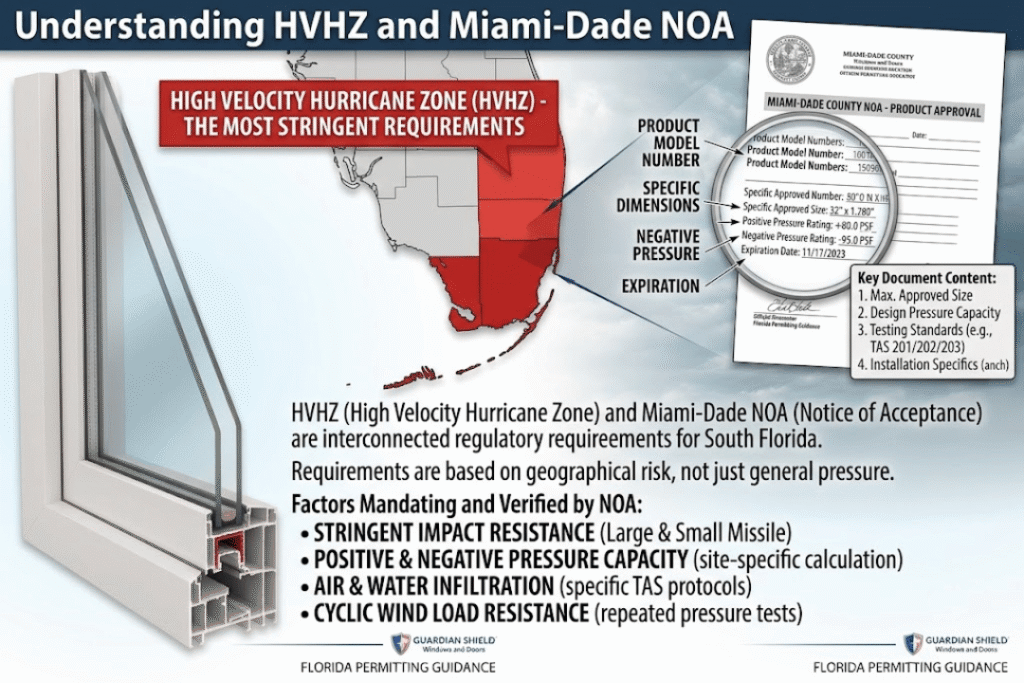
The High Velocity Hurricane Zone, commonly called the HVHZ, applies to:
Miami-Dade County and Broward County.
Properties in these areas are subject to additional hurricane-related product and construction requirements.
This is why you frequently see manufacturers advertise:
- HVHZ approved;
- Miami-Dade approved; or
- Miami-Dade NOA.
However, these terms should still be connected to the exact product and configuration being installed.
What Is a Miami-Dade NOA?
NOA stands for Notice of Acceptance.
Miami-Dade County’s Product Control system provides approvals for building products that satisfy applicable testing and documentation requirements.
For window and door permitting, Miami-Dade requires current approval documentation and identifies the product approval numbers associated with the installed windows and doors.
An NOA can contain important information such as:
- product model;
- window type;
- frame material;
- impact classification;
- design-pressure tables;
- maximum sizes;
- glass configurations;
- anchorage;
- substrates;
- installation limitations; and
- expiration date.
This documentation is far more useful than relying on a sales brochure stating that a window is “hurricane proof.”
Is Florida Product Approval the Same as a Miami-Dade NOA?
They are different approval pathways.
Depending on the location and application, Florida Product Approval or Miami-Dade approval documentation may be used to demonstrate compliance.
Miami-Dade’s window and door permitting guidance states that Florida Building Commission product approvals are acceptable in relevant permitting documentation.
Your contractor should identify which approval applies to the exact product being proposed.
How Do I Know What DP Rating My Home Needs?
You cannot accurately determine the required Design Pressure from the window alone.
The required pressures need to be established based on the building and applicable design conditions.
A site-specific evaluation may consider:
Property Location
Wind design requirements vary geographically.
Building Height
Upper-level openings can experience different wind conditions from ground-floor openings.
Exposure
A home surrounded by closely spaced buildings may experience different wind exposure from a property facing large unobstructed terrain or water.
Building Geometry
Corners, edges and roof shapes affect pressure distribution.
Window Location
Different surfaces and zones of the building experience different pressures.
Window Size
Larger openings can change the capacity of a particular window configuration.
Product Configuration
Glass type, mullions, frame arrangement and anchorage can affect approved performance.
This is why the answer to:
“What DP window should I buy?”
is usually:
Determine the required pressure for the opening first, then select a product configuration approved to meet or exceed it.
Do Miami-Dade and Broward Homes Need Stronger Impact Windows?
Properties in Miami-Dade and Broward fall within the HVHZ, so they are subject to the HVHZ provisions applicable to the project.
But even within the HVHZ, you should not assume that every window on every building needs the exact same DP rating.
The required pressure remains project-specific.
Miami-Dade approval documents themselves state that pressure requirements are determined separately under the governing code and must be less than or equal to the product’s approved positive and negative design-pressure capacity.
That is an important distinction.
HVHZ tells you about the regulatory environment. It does not replace site-specific pressure calculations.
What About Homes Outside Miami-Dade and Broward?
Homes outside the HVHZ can still be subject to significant wind and wind-borne debris requirements.
Florida’s hurricane exposure is not limited to South Florida.
Homes in coastal and hurricane-prone areas throughout the state may still require impact protection and appropriately rated windows and doors based on applicable code criteria.
This is why an installer should evaluate the actual property rather than automatically recommending the same product throughout Florida.
Does a Higher DP Rating Always Mean a Better Window?
Not necessarily.
A higher approved pressure capacity can be valuable where it is required, but homeowners should not select windows based solely on the biggest number.
A successful impact-window project needs the correct combination of:
- required pressure;
- impact resistance;
- opening dimensions;
- approved configuration;
- glass package;
- structural attachment;
- installation;
- energy performance;
- operating style; and
- architectural requirements.
Buying substantially more pressure capacity than required does not automatically make one product the best choice for every home.
Window Size Can Change the Rating
This deserves special attention.
Suppose a product is marketed as capable of a certain high DP rating.
That does not necessarily mean every possible size of that window achieves the same value.
Current Miami-Dade product approval tables show variations in positive and negative design-pressure capacity across different window dimensions.
Always evaluate the actual configuration being ordered.
Mullions Matter Too
When two or more windows are joined within a larger opening, mullions may become part of the engineered assembly.
Miami-Dade permitting guidance specifically calls for the product approval numbers and sizes of mullions where applicable.
Large window combinations therefore deserve careful attention.
The individual windows may be approved, but the complete assembly still needs to satisfy the required conditions.
Installation Must Match the Approved System
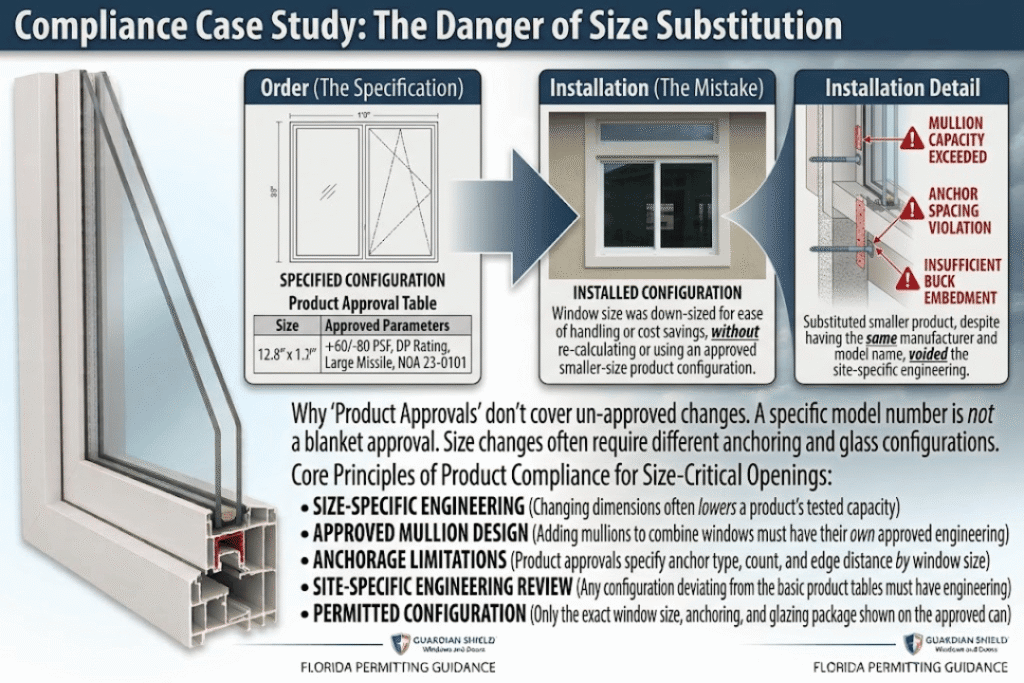
Even the correct DP rating cannot compensate for incorrect installation.
Product approvals can specify:
- anchor types;
- anchor spacing;
- edge distances;
- embedment;
- substrates;
- buck requirements; and
- mullion connections.
Miami-Dade documentation notes that the anchorage methods shown in approved systems are designed to resist the wind loads corresponding to the required Design Pressure.
Changing the installation method without appropriate engineering or approval can compromise the basis on which the system was tested and accepted.
Don’t Buy Impact Windows Based Only on Hurricane Category
You may hear claims such as:
“This window is rated for a Category 5 hurricane.”
That statement alone doesn’t tell you enough.
A homeowner should instead ask:
- What is the applicable product approval?
- Is this configuration impact resistant?
- What are its positive and negative DP capacities?
- What pressures are required for my openings?
- Is my property in the HVHZ?
- Is this exact size approved?
- What glass configuration is included?
- How will the product be anchored?
- Are mullions properly approved?
- Does the installation match the approval?
Those questions provide far more useful information than a hurricane-category marketing statement.
What Florida Homeowners Should Ask Their Installer
Before ordering impact windows or doors, ask your contractor to explain:
- What Design Pressure is required for each opening?
- What positive and negative DP does the proposed product provide?
- What Florida Product Approval or Miami-Dade NOA applies?
- Is the exact window size covered by the approval?
- What impact classification does it have?
- Does the property fall within the HVHZ?
- What glass configuration will be installed?
- How will the windows be anchored?
- Are mullions required?
- Who handles permits and inspections?
A homeowner shouldn’t need to become a structural engineer.
But your contractor should be able to explain why the proposed window is appropriate.
What Florida Building Code Is Currently in Effect?
As of August 2026, Florida is operating under the 8th Edition (2023) Florida Building Code for current projects, while the Ninth Edition (2026) is scheduled to become effective on December 31, 2026. Miami-Dade has already published notices concerning the transition.
Because codes and approvals change, homeowners should rely on the requirements applicable to their project’s permit date rather than an older blog post or sales brochure.
The Right Impact Window Rating Is Property-Specific
There is no single “Florida impact window rating” that every homeowner should buy.
Your required window performance depends on the building, opening and location.
The process should work in this order:
1. Determine the requirements for the property and opening.
↓
2. Determine the required positive and negative pressures.
↓
3. Confirm whether impact protection and HVHZ requirements apply.
↓
4. Select an approved product configuration that satisfies those requirements.
↓
5. Install it according to the applicable approval and permit documentation.
Guardian Shield Windows and Doors can help Florida property owners evaluate impact-window and door options based on the actual requirements of their project.
When hurricane protection is involved, the goal isn’t to purchase the window with the biggest number on the brochure.
It’s to select the correct approved system for the opening and install it the way that system was designed to perform.
Need Help Choosing the Right Impact Window Rating?
Choosing hurricane impact windows should not come down to picking the product with the highest DP number or relying on a “Category 5 rated” marketing claim.
Guardian Shield Windows and Doors helps Florida homeowners and property owners select impact windows and doors based on the specific needs of their project.
Contact us today to schedule a consultation and discuss the right impact window and door options for your Florida property.