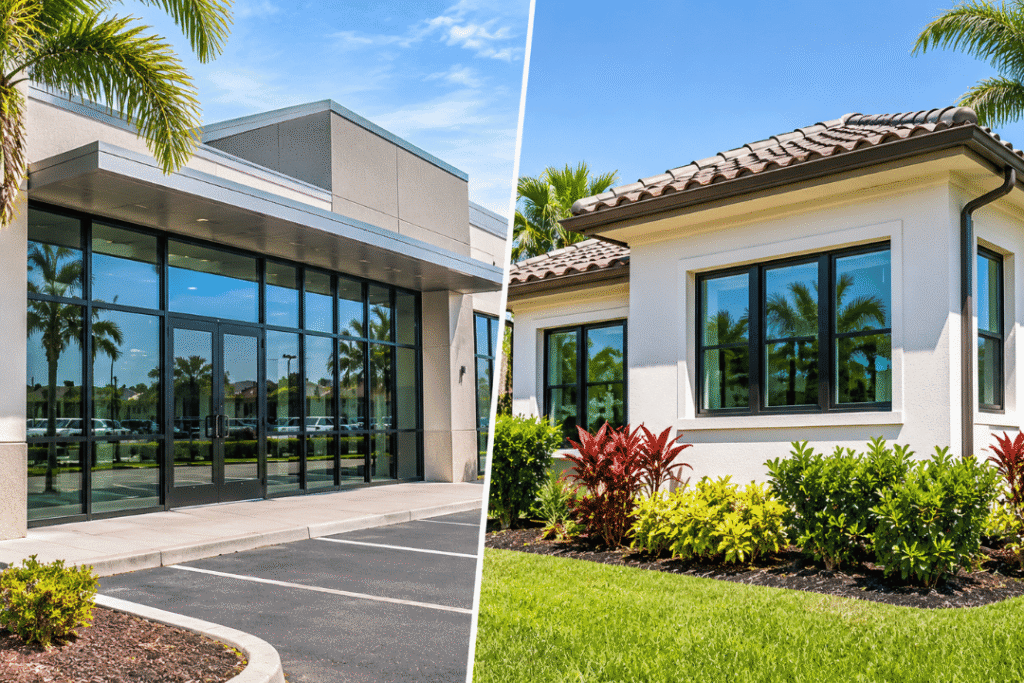
Commercial and residential impact glass projects rely on the same core idea: laminated glass in a tested frame, installed exactly as its product approval requires. Where they differ is almost everything around the glass.
Commercial projects follow a different volume of the Florida Building Code, use larger framing systems like storefronts and curtain walls, usually require more engineering and paperwork, and must be coordinated with general contractors, other trades, and businesses that need to stay open.
Residential projects are smaller, but they happen inside someone’s home, which brings its own responsibilities.
Here is how the two compare, and the lessons that apply to every project, big or small.
Commercial Vs. Residential At A Glance
| Residential projects | Commercial projects | |
| Main code | Florida Building Code, Residential (one- and two-family homes and most townhouses) | Florida Building Code, Building (businesses, condos and apartments, mixed-use, public buildings) |
| Typical products | Single-hung, casement, and horizontal rolling windows; sliding glass doors; French and entry doors | Storefront systems, curtain walls, window walls, impact entrances, and automatic doors |
| Engineering | Often covered by the product approval and standard permit documents | Frequently requires signed and sealed shop drawings and anchorage calculations |
| Who you work with | The homeowner | Owner, architect, engineer, general contractor, and other trades |
| Accessibility rules | Generally not required for private homes | ADA Standards and the Florida accessibility code apply to entrances and doors |
| Schedule | Usually days on site | Often phased over weeks or months around other work and business hours |
Codes And Wind Requirements
Where Impact Protection Is Required
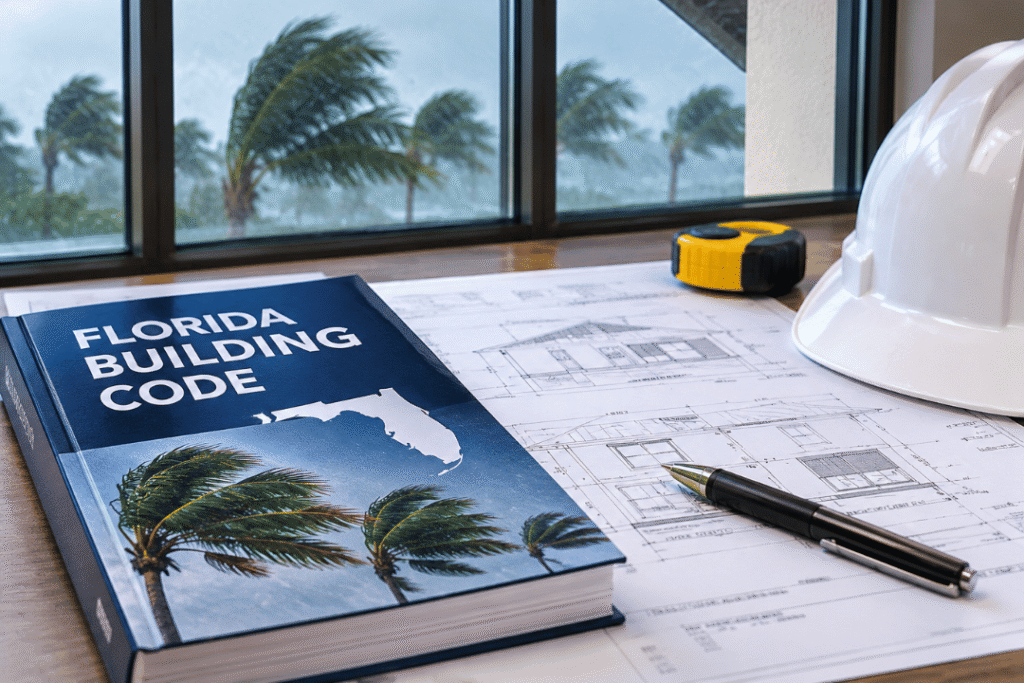
Under the Florida Building Code, glazed openings in wind-borne debris regions must be impact resistant or covered by an approved impact protection system, such as shutters. Wind-borne debris regions include areas where the ultimate design wind speed is 140 mph or more, and areas within one mile of the coast where it is 130 mph or more. Large parts of Florida fall into one of these categories.
Miami-Dade and Broward counties are part of the High-Velocity Hurricane Zone (HVHZ), which has its own, stricter testing protocols (TAS 201, 202, and 203). Products used there need approval for HVHZ use, typically a Miami-Dade Notice of Acceptance.
Residential Projects
Most single-family homes and townhouses fall under the Florida Building Code, Residential. Window and door replacements still need products with Florida Product Approval or a Miami-Dade NOA, a design pressure rating that meets the requirements for the home’s location, and a permit with inspections.
Commercial Projects
Commercial buildings, including condominium and apartment buildings, fall under the Florida Building Code, Building. The same impact requirements apply, but the buildings are often taller, larger, and more exposed. Wind pressure generally increases with height, and the corners of any building see higher pressures than the middle of a wall. That means one commercial project can call for several design pressure ratings across different elevations.
Large Missile Vs. Small Missile Testing
Impact glass is tested by firing objects at it to simulate storm debris. Under ASTM E1996 and the HVHZ protocols, glazing within 30 feet of grade must pass the large missile test, which uses a 9-pound 2×4. Glazing higher than 30 feet faces mainly roof gravel and smaller debris, so it may be tested with the small missile test, which uses steel balls.
For homes, nearly every window is within 30 feet of the ground, so large missile products are the norm. On mid-rise and high-rise commercial buildings, the upper floors may use small missile rated products, while the lower floors require large missile rated glass.
Products And Systems
Residential Products
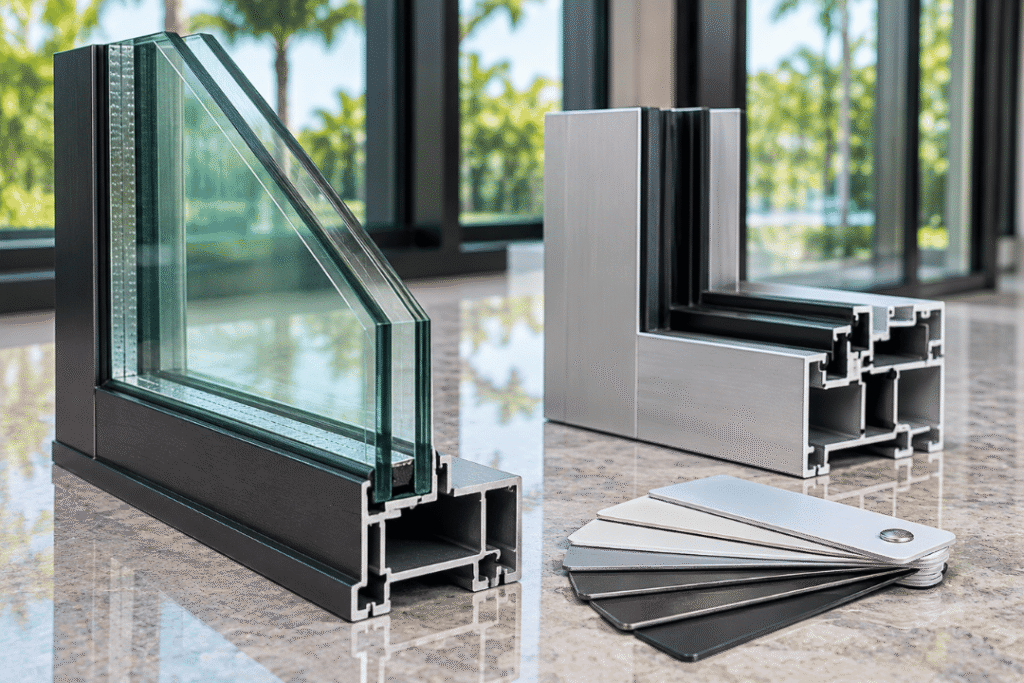
Homes typically use individual window and door units: single-hung, casement, horizontal rolling, and picture windows, plus sliding glass doors and hinged French or entry doors. Each unit arrives as a complete, tested product and is anchored into a block or wood-framed opening.
Commercial Systems
Commercial buildings more often use framing systems that are assembled on site:
- Storefront systems are aluminum-framed glass walls, usually on the ground floor of retail and office buildings.
- Curtain walls are non-load-bearing glass and aluminum walls that hang from the building structure and can span several floors.
- Window walls sit between floor slabs and are common on condominium and apartment towers.
- Impact entrances and automatic doors handle heavy daily traffic and must meet accessibility rules.
Because these systems are larger and carry higher loads, glass thickness, framing depth, and anchoring are often more substantial than on homes.
Glass Selection And Energy Code
Both project types must meet the Florida Building Code, Energy Conservation. On commercial buildings, the code sets limits on window U-factor and solar heat gain, and large glass areas make those numbers matter even more. The same principle helps homeowners: choosing the right Low-E glass is one of the best ways to control energy costs in Florida’s climate.
Engineering, Paperwork, And Testing
This is where commercial and residential projects differ most.
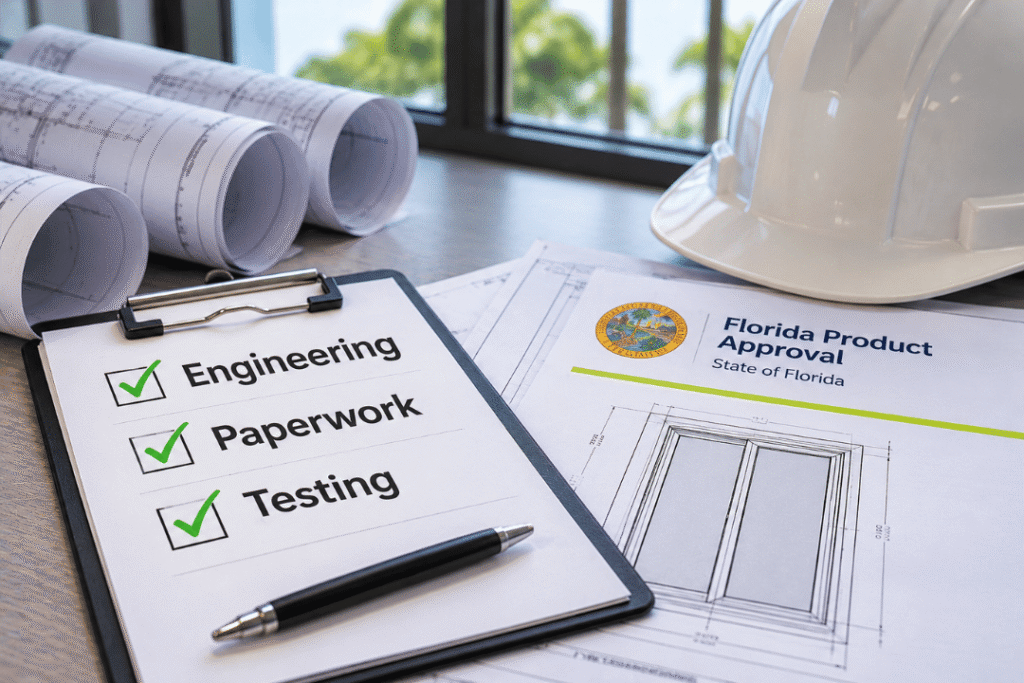
- Shop drawings and calculations. Commercial projects frequently require shop drawings and anchorage calculations, often signed and sealed by a Florida-licensed engineer, before fabrication can begin. Residential replacements are often covered by the product approval’s standard installation details.
- Submittals and approvals. On commercial work, the architect or engineer usually reviews product data, glass samples, and approvals before anything is ordered.
- Field testing. Commercial specifications may call for water testing of installed windows and storefronts using industry standards such as AAMA 502 and AAMA 503.
- Accessibility. Commercial entrances must follow the ADA Standards and the Florida Building Code, Accessibility. That includes requirements such as a minimum 32-inch clear door opening and thresholds no more than 1/2 inch high in most cases.
- Bonds and insurance. Public projects and many large private projects require additional insurance and, often, payment and performance bonds.
Scheduling And The Job Site
Commercial: Coordination Is Everything
On a commercial project, glazing is one trade among many. Openings must be ready on time, other trades need access, and inspections have to happen in the right order. In occupied buildings, the work often has to be phased so a business can keep serving customers, sometimes with after-hours installation and temporary protection for open storefronts. Custom systems can also have longer lead times, so ordering early is critical.
Residential: Working Inside Someone’s Home
Residential projects move faster, but they happen in the space where a family lives. Protecting floors and furniture, controlling dust, keeping pets and children safe, and leaving the home clean at the end of each day are just as important as the installation itself. One Guardian Shield customer noticed exactly that:
“They took the time to cover and protect the surrounding areas with tarps to keep dust and debris from getting into my home.” — Darlene F., Google review
Lessons That Apply To Both
- The approval is the rulebook. Whether it is one window or a full curtain wall, the product must be installed exactly as its approval and drawings require. That is the heart of installation done right.
- Measure and verify the openings. Out-of-square block openings in older homes and slab edges that do not match the drawings on commercial jobs cause the same kind of delays.
- Water management matters. Most leaks come from how a system is flashed, sealed, and drained, not from the glass.
- Communication prevents problems. Clear timelines and a single point of contact help homeowners and general contractors alike.
- Think beyond storms. Laminated glass also offers break-in resistance, noise reduction, and UV protection for homes and businesses.
- Plan for upkeep. Both homes and commercial buildings last longer with regular maintenance of seals, tracks, and hardware.
Frequently Asked Questions
Is commercial impact glass different from residential impact glass? The basic technology is the same: laminated glass in a tested frame. Commercial systems are often larger and may use thicker glass and deeper framing to handle higher wind loads and bigger openings.
Do commercial buildings in Florida need impact glass? In wind-borne debris regions, glazed openings must be impact resistant or protected by an approved system such as shutters. Many businesses choose impact glass so they are protected without installing shutters before every storm.
What is the difference between large missile and small missile impact glass? Large missile products are tested with a 9-pound 2×4 and are required for glazing within 30 feet of grade. Small missile products are tested with steel balls and may be used higher up.
Do condo buildings follow commercial or residential code? Condominium and apartment buildings generally fall under the Florida Building Code, Building, not the Residential code. Individual unit owners should also check with their association before replacing windows or doors.
Why do commercial projects take longer? They often require engineered shop drawings, design team approvals, custom fabrication, and coordination with other trades and inspections.
Talk To Guardian Shield About Your Project
Whether you are upgrading your home or planning a commercial impact glass project, Guardian Shield Windows and Doors brings 15 years of Florida experience to every job. We work with leading manufacturers, follow every product approval, handle permits and inspections, and keep you informed from the first visit to the final sign-off.
Call (813) 830-1170 today for a free estimate on your residential or commercial project.